Introduction
Hschain-utxo is a framework to create blockchains based on UTXO-model with rules that are defined with smartcontracts. It runs on top of hschain consensus protocol.
To define smartcontracts hschain-utxo uses special language that is inspired by ErgoScript. The framework consists of several parts:
the language for smartcontracts
interpreter for the language to try out ideas
service to run blockchain
client to post transactions and query useful information with API
Language of smart contracts
Language of smartcontracts is staticly typed higher-order functional programming language with predictable time of exectuion and zero-knowledge prooves of the ownership of the values. It adapts powerful functional programming paradigm to the requirements of the safe, fast and predictable execution of the scripts on the blockchain.
Main features of the language:
Language operates on the flexible UTXO-model which excludes double spending. The scripts protect values from being spent and execution of transaction that proves ownership of the values creates new protected inputs.
Ownership of the values is bases on Sigma-protocols. Sigma-protocols allow the user to create intricate conditional rules for proving the ownership. Instead of fixed model of ownership we can devise our own rules. Rules are arbitrary boolean expresisons. It makes system flexible and provides the user with tools to create rules suitable for a specific task.
Alongside with Sigma-protocols we can use Bitcoin-like signatures. There are primitives for single ownership and multi-signatures.
Rules of the ownership are zero-knowledge prooves of the private-key ownership. The proove validation does not compromise the owner of the key and the key itself.
Ownership prooves can depend on the current state of the blockchain. It provides the user with means to create rules that dpeend on time of execution and create time-bounded contracts.
To make termination predictable we prohibit usage of recursion. User can not create recursive functions and recursive types. It restricts the language but nonetheless intricate behaviours can be achieved with sequence of transactions. It solves the problem of termination without the need to follow more intricate models like GAS-usage or artificial restriction on the number of executed instructions which are not obvious for the user.
Scriping language is a high level functional programming language. For fast execution it is compiled to low-level language.
Language is staticly typed with automatic type-inference and type-checking. It protects user from many posible errors and increases the safety level.
Smart contracts are used to protect UTXOs from illegal spending. To define what is legal we have a language. It encodes conditions for protection of the values in UTXOs. Our language is based on ErgoScript. For now it’s typed lambda-calculus with support for sigma-protocols. Sigma-protocols define a way to protect the values with cryptographic algorithms. Sigma-protocols let us prove that user owns private key without exposure of the private key itself.
Let’s look at example of the simplest script:
pk alice
pk is a function that evaluates to true only if user can prove that he or she
is owner of the alice secret key.
Also we can use conditions and boolean operators:
pk alice || (pk bob && getHeight > 100)
In this transaction Alice can grab the value or Bob can have it if the height of the blockchain is greater than 100.
UTXO-model and smartcontracts
Unspent Transaction Output (UTXO) model describes exchange of values. It was invented for Bitcoin blockchain and successfully implemented there. It allows us to model exhange of any values in quite smart way.
Suppose that user holds some amount of values and we want to transfer value from one user to another. The value is represented by UTXO that can become an input for the future transaction. If Alice wants to send 10 coins to Bob she can use her UTXO as input and create another UTXO for Bob that will contain 10 coins. The UTXO is often protected by the user signature. So in order to spend the transaction we need to prove that we hold the value for this output.
Here is the state of the Blockchain prior to transaction:
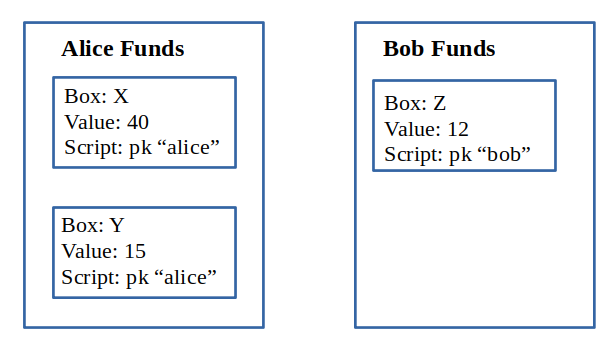
We can see that Alice has two boxes with values and Bob has only one. Each box has unique identifier, value and script that protects the value The ownership by the user is encoded with the script. In the system we have no users such as Alice or Bob. We have only keys and prooves of ownership.
Let’s suppose that Alice wants to send 10 coins to Bob. Bob sends his public key to Alice.
She creates a transaction with her Y box as input and creates two boxes as output.
One box for Bob wich holds 10 coins and protects them with Bob’s public key.
The second box is for Alice to send back the remainder of the value from the original Box.
By the rule sum of the inputs should be equal to the some of the outputs,
otherwise transaction is considered to be invalid. Let’s look at the Alice’s transaction:
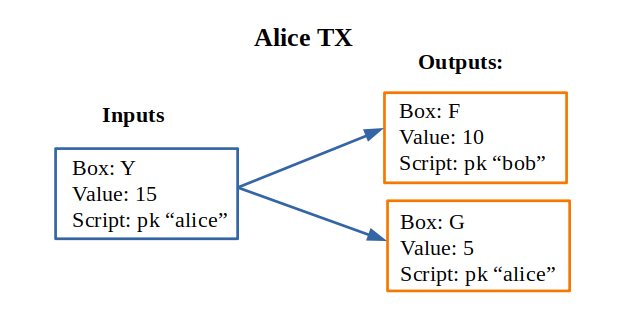
After that Alice prooves with her key that she holds the Box Y. The TX is
validated and commited and as a result it destroys the Box Y and creates
two new Boxes F and G that now can be used as inputs to other transactions.
Alice sends the identifier of the box F to Bob so that he can use it.
Identifier of the box is determined as a hash of content of the box and metadata (TX that
originated the Box and the identifier of the TX-output which references the box).
In this example scripts are very simple but they
can be programs on their own to encode more complex scenarios.
Let’s look at the state of blockchain after TX was approved:
Once UTXO is spent it is destroyed and in place of it we have new UTXOs. That’s how smartcontracts work. We use UTXOs in the blockchain as inputs check conditions in the smartcontract and if it holds true we destroy inputs and substitute them with outputs.
- Smart contract
Is a script that evaluates to true or false. It defines the rules to spend UTXOs.
- Transaction
Transaction tries to use UTXOs that exist in the system and turn them to another UTXOs. TX takes in UTXOs of the blockchain and environment variables (like height of the blockchain) that checks condition and if it evaluates to true it destroys the inputs and produces new UTXOs as outputs.
- Unspent transaction output (UTXO)
Box that contains a value that can be used as input for transaction and it is protected by the script (smartcontract). It can define rules for smartcontracts that try to spend the value.
- Block
Contains a list of transactions. It can be though of as execution of transaction in batch mode. If all transactions in the block are valid it is executed on the blockchain and it is said to be commited.
- Blockchain
For UTXO-model blockchain is a set of UTXOs that can be spent and global time of execution which corresponds to the number of commited blocks.
The structure of the project
The modules are separated for the parts:
hschain-utxo-langdefines language of smartcontracts and model of execution and key termshschain-utxo-compilerutility to compile scripts and prove ownership of the transactionhschain-utxo-statedefines blockchain and rules to commit the blocks and transactionshschain-utxo-serviceis service to run a nodehschain-utxo-apiis API to interact with blockchainhschain-utxo-replinterpreter for the languagehschain-utxo-testtest scripts to verify that everything works finehschain-utxo-pow-nodePOW-node for blockchainhschain-utxomain application and utility tools (to generate genesis for instance)
Let’s look at the scheme of project structure
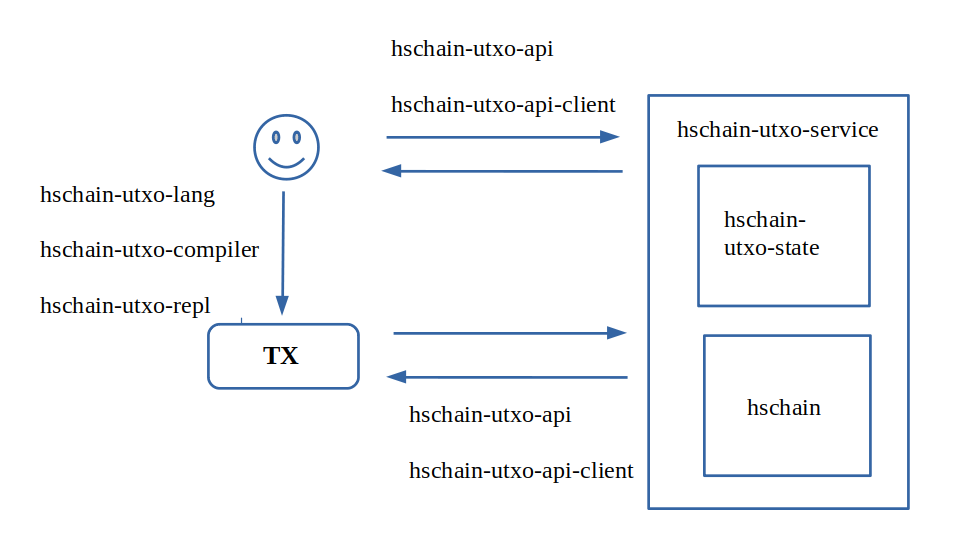
User creates TXs with hschain-utxo-compiler. User compiles script language that is defined in the package hschain-utxo-lang. He can use repl (hschain-utxo-repl) to try out ideas. User sends transactions to web-service (hschain-utxo-service) over API (hschain-utxo-api). The service runs on top of hschain which handles transactions and manages state transactions. State itself and the way to react to TXs is described in the package hschain-utxo-state.
Blockchain node
Blockchain node runs a service that accepts postage of blocks by REST API. It uses hschain as aconsensus algorithm to make commits consistent accross the network. We can run the node like this:
cabal new-run hschain-utxo-service
It accepts config and genesis see corresponding section for details.
API
We can use REST API to post transactions and query useful information.
The clinets are defined in the module hschain-utxo-api see the corresponding section
for details.